Holcim UK opens new Sunderland rail route to safeguard North East asphalt supply
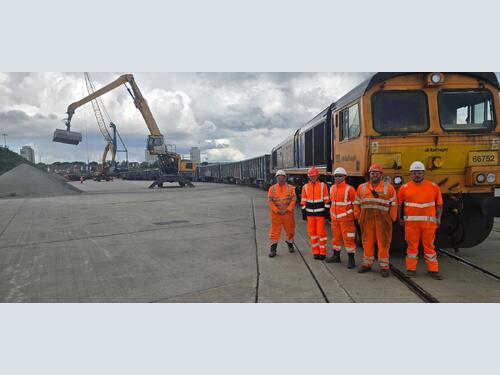
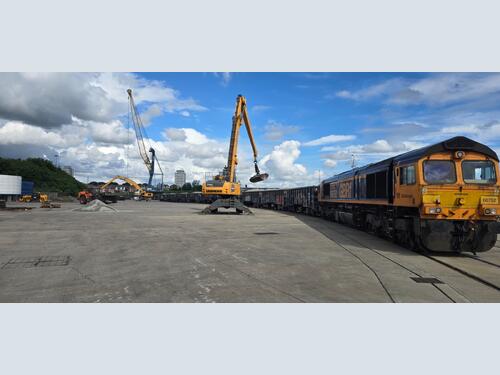


• Each train currently carries 19 wagons and approximately 1,425 tonnes of material.
• Each 1,425t train delivery is the equivalent of 70 rigid lorry movements or 52 articulated vehicles.
• The route is expected to deliver around 100,000 tonnes within its first 12 months.
Holcim UK has launched a new rail freight route into the Port of Sunderland, which is set to move around 100,000 tonnes of aggregate in its first year, strengthening asphalt supply across the North East and easing pressure on established logistics routes in a challenging regional market.
The new flow began operation in summer 2026 and currently brings around one train per week into Sunderland. Each service carries 19 wagons and approximately 1,425 tonnes of material, with 14 services already delivering nearly 20,000 tonnes to date. The route is expected to reach around 100,000 tonnes in its first 12 months, creating a dependable supply line that can flex as market demand increases.
The project was developed after Holcim UK identified an opportunity to use Sunderland’s existing railhead as an alternative route for bringing aggregate into the region. The material will be used in asphalt production, primarily supporting Northumbrian Roads and also supplying Hulands Asphalt, helping serve the wider North East market. With changing supply arrangements at the Port of Tyne putting pressure on established logistics routes, the Sunderland railhead offered a practical way to keep material moving, protect the competitiveness of local asphalt production, reduce exposure to road haulage costs and make better use of existing infrastructure.
It has also created additional value for the Port of Sunderland, which has been looking to increase bulk freight volumes and make greater use of its rail capability. The port’s existing handling equipment, storage space and appetite to grow rail traffic helped Holcim UK move quickly from feasibility discussions to a live weekly freight flow.
The route lands at a significant moment for UK freight. Government has set a target for at least 75% growth in rail freight by 2050, reflecting the role rail can play in strengthening supply chains, moving construction materials efficiently and reducing pressure on roads. For Holcim UK, the Sunderland flow turns that national ambition into a working example of how modal shift can support day-to-day operations in a live regional market.
Mustapha Nyass, Regional Operations Manager at Holcim UK, said: “Reliable asphalt supply is critical to keeping North East construction and infrastructure projects moving, from road maintenance to wider regional development. This new route gives us a stronger, more resilient way to get essential materials into the market, so customers can plan with greater confidence.
“We faced a real supply challenge, but the answer was not simply to absorb higher costs or accept less flexibility. By using Sunderland’s railhead, storage space and port capability, we have created a practical new route that supports local construction, strengthens our asphalt operations and gives us room to grow when demand increases.”
The route also demonstrates the operational impact of modal shift when it is applied to a live supply chain rather than treated as an abstract ambition. Road haulage was not commercially realistic for the volume required, while ship movements remain dependent on vessel size, source location and port capacity. Rail offered the balance Holcim UK needed: enough volume to move material efficiently, enough flexibility to use open box wagons, and enough existing infrastructure to avoid major new capital investment.
Damien Preece, General Manager - Rail at Holcim UK, said: “Rail only works when the operational detail works. You need the material, the wagons, the paths, the route knowledge and a receiving site that can handle the flow safely. Sunderland lined up on all those points, which is why the project moved from an idea to a weekly freight movement so quickly.
“The other important point is utilisation. Railheads and wagons carry fixed costs, so the more volume you can move through them, the stronger the economics become. Adding Sunderland has increased the use of wagons we already had committed, brought more volume through an underused railhead and made the wider network work harder. That is where modal shift becomes valuable. It improves the cost base, strengthens supply resilience and gives operations more options.”
Delivery of the route required close coordination between Holcim UK’s asphalt, aggregates and logistics teams, alongside GB Railfreight and the Port of Sunderland.
The use of open box wagons is central to the route’s flexibility. While they require more manual handling than automated bottom-discharge wagons, they can be deployed without significant fixed infrastructure, allowing material to be discharged using existing port equipment. With storage capacity of up to 6,000 tonnes at the Port of Sunderland, the model gives Holcim UK a practical way to build rail volume without the cost and lead time of major new infrastructure.