The Right Block for the Right Job: Why Concrete Product Compliance cannot be left to chance


Concrete blocks are widely used throughout the quarrying and mineral products sector, but not every block is suitable for every application. Owen Batham of Elite Precast Concrete explains why product strength, structural design, fire performance and traceability must all form part of the purchasing decision.
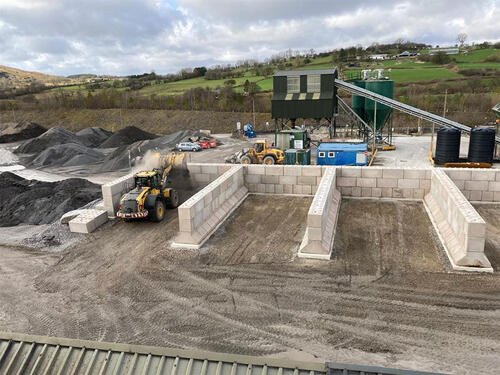
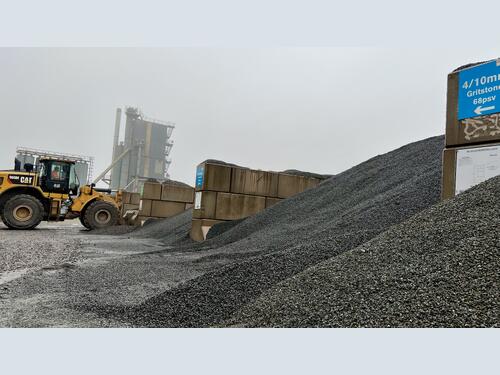
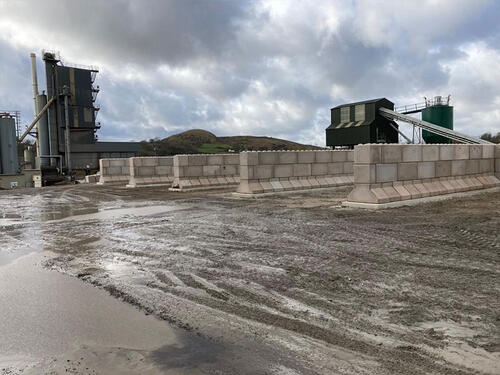
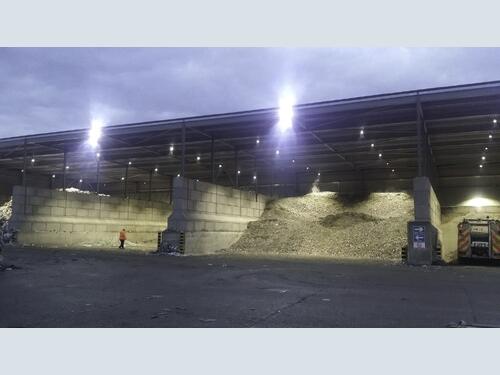
Concrete blocks have become a familiar sight across quarrying, aggregate, recycling and mineral-processing sites. Their modular nature makes them a practical choice for constructing aggregate storage bays, material separation walls, traffic-management systems, security barriers and other essential infrastructure.
However, the apparent simplicity of these products can create a dangerous misconception: that one concrete block is much the same as another. They are not.
Concrete blocks can vary considerably in their mix design, compressive strength, density, reinforcement, interlocking profile, dimensional accuracy and manufacturing controls. A product that may be adequate for a temporary, low-level installation will not necessarily be suitable for a tall storage bay, a retaining structure or an area where fire is a foreseeable risk.
Selecting a product because it looks similar, fits the available space or carries the lowest initial price may expose quarry operators, contractors and specifiers to avoidable structural, operational and legal risks.
Start with the intended application
The first question should always be: what is the block expected to do?
A block used as a simple site demarcation feature faces very different demands from one forming part of a retaining wall or bulk-material storage bay. Retaining and storage structures can be subjected to considerable horizontal pressure from the material behind them, as well as forces generated by loading shovels, excavators and other mobile plant.
Material density, moisture content, wall height, surcharge loads, vehicle movements, ground conditions and the proposed block arrangement can all influence the performance of a structure.
A block’s weight alone does not confirm that it is suitable. Neither does its physical size or appearance. The completed wall must be considered as a system, with an appropriate design based on the site conditions and intended use.
Where a wall is expected to retain material, support operational loads or protect people and plant, the user should request suitable design information. This may include calculations, maximum safe wall heights, installation drawings, foundation requirements and restrictions on use.
If a manufacturer cannot provide meaningful technical information about the product or its intended applications, that should be treated as a warning sign.
Understand what is inside the block
Concrete performance depends heavily on its constituents and how the product is manufactured.
The problem arises when the composition of a product is unknown, inconsistent or unsupported by appropriate test evidence. Variable feedstocks and uncontrolled inclusions may affect strength, durability, density and fire performance.
Operators should therefore avoid relying on broad descriptions such as “heavy-duty”, “high strength” or “fire-resistant” without supporting documentation. These terms should be backed by measurable properties and evidence relevant to the finished product.
Purchasers should ask the manufacturer to confirm:
- The specified concrete strength
- The product’s dimensions and declared weight
- The materials used in its manufacture
- The manufacturing and quality-control procedures
- Relevant test results and technical documentation
- The standards or specifications to which the product is manufactured
- Any limitations affecting its use
Concrete products should be purchased on evidence, not appearance or assumption.
Fire performance must be demonstrated
Fire is an increasingly important consideration for quarry, waste, recycling and materials-processing sites.
Combustible waste, fuel, oils, tyres, batteries and machinery can create a substantial fire load. Lithium-ion batteries entering waste and recycling streams present a particular challenge because damaged or defective batteries can ignite rapidly and may be difficult to extinguish.
Concrete is inherently non-combustible and can provide valuable passive fire protection. However, stakeholders should not assume that every product described as a concrete block automatically carries the same fire classification or will perform identically in a fire.
The composition of the finished product matters. Manufacturers making claims about reaction-to-fire performance should be able to provide evidence supporting those claims, including the applicable classification and the basis on which it has been achieved.
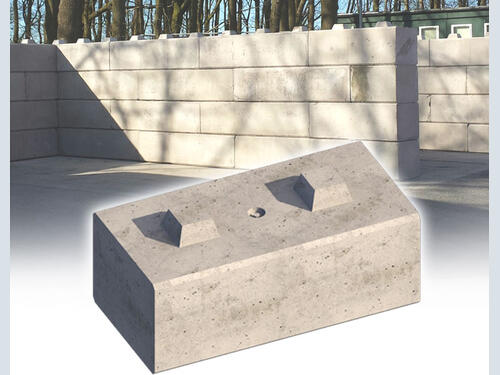
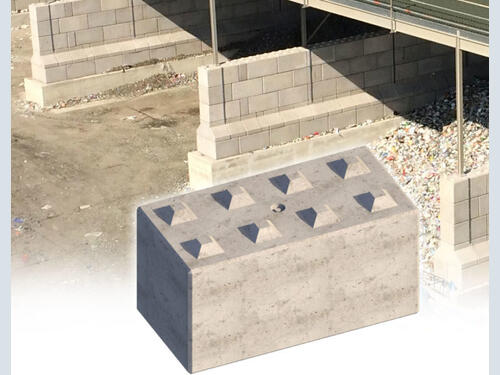
For example, Owen continues, "Elite Precast Concrete’s Legato® interlocking blocks are classified as Class A1 in accordance with the relevant provisions of BS EN 13369. This provides specifiers and site operators with clear, documented information rather than an unsupported statement that the product is simply “fireproof” or “fire-resistant”.
"It is also important to distinguish between reaction to fire and fire resistance. A reaction-to-fire classification considers how a product contributes to the development and spread of fire. Fire resistance relates to the ability of a complete element or structure to maintain functions such as integrity, insulation or loadbearing capacity for a stated period.
"A non-combustible block does not, by itself, establish a fire-resistance period for every wall configuration. The design, joints, height, layout and intended function of the completed structure must all be considered."
Non-conforming products create shared risks
The consequences of installing an unsuitable or non-conforming product can extend far beyond the original purchasing decision.
A wall failure could result in injury, damage to machinery, contamination of materials, production delays and costly reconstruction. In a fire, an inadequately specified product or structure could fail to provide the anticipated level of containment, increasing the potential for fire to spread to neighbouring stockpiles, equipment or buildings.
There may also be insurance, contractual and regulatory implications if products cannot be traced or if performance claims are unsupported.
Responsibility does not rest solely with the manufacturer. Specifiers, distributors, contractors, installers and end users all have a part to play in ensuring that products are appropriate for their intended use.
Procurement teams must understand that accepting an alternative product is not simply a commercial substitution. If the alternative has different structural properties, fire performance or technical limitations, the original design may no longer be valid.
Likewise, contractors should not change block types, layouts or wall heights without confirming the implications with the relevant designer or supplier.
Traceability provides confidence
A reputable manufacturer should be able to trace its products to controlled production processes and provide clear technical data.
Traceability becomes particularly important when investigating defects, confirming product performance or demonstrating that the correct materials were supplied. Products manufactured from unidentified or poorly controlled sources may be difficult to verify once they have arrived on site.
Quarry operators and contractors should retain product data sheets, delivery records, design information, installation drawings and relevant declarations or certificates as part of the project file.
These records provide evidence that reasonable checks were undertaken and help ensure that future site teams understand what has been installed and how it should be used.
Communicate requirements throughout the supply chain
Good product selection depends on clear communication. The designer may understand the loads acting on a storage wall, but this information must reach the procurement team. The manufacturer may specify a maximum wall height, but that information must reach the installer and site operator. The purchasing team may agree to a substitute product, but the designer must be given the opportunity to assess it.
All stakeholders should understand:
- What the structure has been designed to contain or retain
- The maximum permitted height
- The density and characteristics of the stored material
- Whether plant can push material directly against the wall
- Any restrictions on surcharge loads
- The required foundation and installation method
- The product’s declared fire performance
- The inspection and maintenance requirements
- The procedure for approving substitutions or alterations
Without this communication, even a correctly manufactured block can be installed or used in a way that creates unnecessary risk. It is the installers responsibility to ensure appropriate structural checks are carried out before any building work begins.
Compliance should be the starting point
The pressure to reduce project costs is understandable, but the lowest-priced block may become extremely expensive if it leads to redesign, replacement, operational disruption or a safety incident.
Concrete blocks used in demanding quarrying applications should be treated as engineered products rather than interchangeable lumps of concrete. Their selection should reflect the function they will perform, the loads they will experience and the environment in which they will be installed.
The industry should expect manufacturers and suppliers to substantiate their claims. If a product is described as high-strength, compliant or Class A1, the evidence should be readily available. If it is intended for a retaining or storage application, suitable design information should support its use.
Owen believes that ultimately, using the right block is not simply about compliance. It is about protecting employees, contractors, equipment, materials and business continuity.
By asking the right questions at the procurement stage and ensuring that information is communicated across the supply chain, quarry operators can avoid false economies and create safer, more dependable sites.
The message is straightforward: specify by performance, verify the evidence and never assume that all concrete blocks are the same.
To find out more, speak to Owen or a member of the Elite team on 01952 588885 or visit www.eliteprecast.co.uk
Associated Businesses