Multi Wheel Classifier transforms productivity
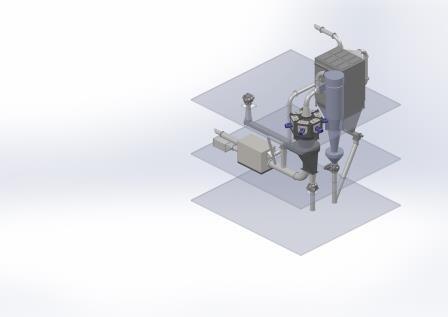
British Rema has recently installed its Multi Wheel Classifier system to address a novel recycling challenge on behalf of a major player in the UK waste recycling industry.
Normally used in the mineral industry to produce sharp cuts down to a few microns at high throughputs, on this occasion the technique was adapted to separate out a hazardous fraction from a high volume waste stream.
As Rob Calvert, British Rema’s technical director commented, “with careful control of system parameters and equipment design, British Rema can often exploit the different physical properties of a mixed input stream, such as particle density and shape, and not just the conventional task of separating a homogenous product stream by particle size alone. A willingness to conduct rigorous trial work is usually the key to success for challenges like this.”
Crucial to the Multi Wheel Classifier’s superior performance are the high-efficiency classifier wheels which are mounted horizontally in a radial configuration. The unit can be supplied with 3, 4, or 6 wheels, with each wheel ranging in size from 300-500mm. The wheels are run on direct drives, with inverters linked harmonically to ensure they run at identical speeds. This is the key to the machine’s excellent sharpness of cut and high fines yield.
Originally designed to handle high volume and aggressive-wear products in the minerals industry such as calcium carbonate, fly ash, quartz, and zircon, the Multi Wheel Classifier system is more energy efficient for high volume applications and occupies a much smaller footprint than traditional processing solutions, such as multiple single wheel classifiers or large unit air separators.
The equipment’s durability can be further enhanced by incorporating ceramic tiles for high wear areas such as the high velocity in-feed cone section and by applying specialist coatings for the wheels.