Harnessing the power of digital twins in earthmoving
The earthmoving industry is navigating significant challenges, including a large-scale skills and labour shortage, increasing fuel, material and infrastructure costs and a growing demand for improved safety.
While the sector is moving towards a digital era, where technology adoption is on the rise, evidenced by 75 per cent of construction professionals utilising AI in their projects*, the earthmoving sector remains hesitant to embrace new technologies.
Bart Vingerhoets, Senior Commercial Manager at Komatsu Smart Construction, shares how adopting digital twins in earthmoving projects can address some of the challenges currently facing the industry.
Bridging the skills gap
The European Centre for the Development of Vocational Training (Cedefop) has estimated 4.2 million construction worker job openings will need to be filled in Europe between 2022 and 2035* to meet projected demand. With an ageing workforce, rising project requirements and a shortage of skilled labour, investment in training and innovative technologies will be essential to futureproof the industry.
Digital twins are revolutionising earthmoving projects by providing a continuous up-to-date representation of a job site. The data within a digital twin can be utilised by AI systems to help optimise resource allocation.
By simulating different scenarios, such as fleet compositions or the sequence of project milestones, AI can assist project managers in deploying machinery and labour more efficiently, ultimately boosting productivity and allowing workers to focus on other tasks.
In terms of training, digital twins assist in upskilling the workforce by improving progress tracking and enabling online logging of completed work, which serves as a reference for future maintenance or modifications.
In addition, digital twins enable real-time tracking of progress, supporting managers in making informed decisions and quickly resolving issues, minimising downtime and keeping projects on schedule.
Collaboration between the workforce is also enhanced, as all stakeholders can access the virtual site model, facilitating better communication and quicker feedback. By automating data analysis and reporting, digital twins free up time spent on administrative tasks, allowing the workforce to focus on critical tasks, leading to improved outcomes in earthmoving projects.
Enabling more productive operations
A key focus for any job site is delivering projects on time and within budget. Digital twins enable predictive maintenance through real-time monitoring, which leads to reduced downtime and increased operational efficiency.
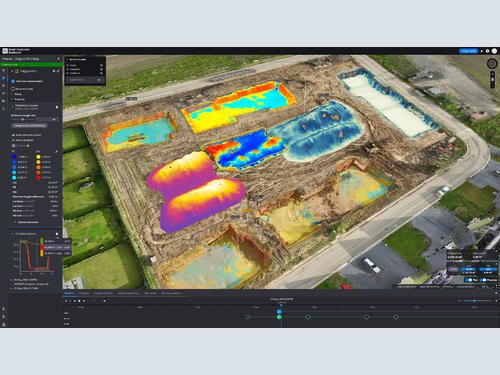
Solutions such as the Smart Construction Dashboard build on this by providing an interactive 3D model that updates continuously in real time via various data streams. This platform allows users to visualise operations, analyse performance data and provides data to run predictive assessments based on historical trends.
Ultimately, digital twins allow for better-informed decision-making whilst enhancing productivity and minimising reliance on guesswork to keep projects on track. As a result, there are fewer delays, less or minimised rework requirements and reduced idling, enabling projects to run more smoothly and efficiently.
Improving safety
A major focus for the industry is creating safer ways of working. Through the virtual job site, managers can establish a safer working environment by proactively identifying and mitigating potential hazards. By analysing real-time data, operators can detect potential risks and run safety trials before executing them in real life, allowing for multiple attempts to ensure that the actual operation is successful.
Sensors and IoT technology enable the digital twin to track the movements of workers, vehicles and equipment, alerting the team when an issue arises. This capability allows for quick, reactive responses to mitigate risks and hazards.
Additionally, site managers can monitor the site virtually, reducing travel time and fuel consumption. This advancement means they don’t need to visit hard-to-reach or dangerous environments, as monitoring can be done from a safe distance.
Digital twins in practice
For Sina Motsch, site manager for HEITKAMP Corporate Group, it was crucial that she
found an easy way to make sense of the job site and make use of the information effectively.
By utilising Dashboard by Komatsu Smart Construction, Sina was able to collect automatic high-density as-built data sourced from the dozer, used to generate an accurate digital twin that was automatically updated as the site changed almost daily.
Using a digital twin of her project site enabled Sina to immediately discover any delays, developments or potential issues across the jobsite without having to visit in person.
Through Dashboard, project managers can track materials and progress as it happens, resulting in a wider status understanding and informing quick decision making.
As technology and digital solutions advance, we can expect to see an increase in earthmoving operators adopting these innovations to meet industry demands and enhance their operations.