Hands up if you know one robot arm from another
By Roger Harris, Regional Sales Manager at FANUC UK
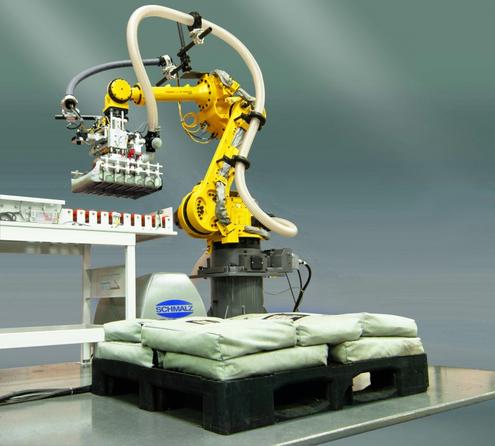
What determines the choice of palletising robot to handle product X at point Y on the line? With a choice of 20+ FANUC robots arms all capable of performing palletising tasks, Roger Harris Regional Sales Manager at FANUC UK picks out some of the main criteria that factories should consider in order to specify the best robot arm for the job.
To the untrained eye, one robot may look very similar to another. In reality, there are a host of variables, not just in the overall type of robot, but in the precise specification which can be tailored to the particular needs of a given application.
A robot may last 20 years in a single installation. If you look after the robot, it will look after you. And ‘looking after’ the robot starts with ensuring that you have the correct specification to begin with.
Any reputable automation specialist will talk potential customers through their detailed needs and how they can best be met. But many of those with robot-shaped gaps at the end of their production lines could benefit from a brief overview of the main considerations:-
1. Cycle time versus speed
Most manufacturers know that in relation to any type of equipment, ‘speed’ is often less useful as a concept than it might appear. This is as true of robots as it is of other machines.
Most robots can be programmed to move extremely quickly - up to around 4000mm/second, but they will need to ramp up to this top speed, and then slow down from it. When the distance of travel is short, the arm will never reach maximum speed. Sometimes, we slow the arm down in order to reduce the cycle time.
By using FANUC Roboguide robot simulation package the system integrator can check to see if the cycle-time is achievable and in turn this can aid robot selection. FANUC Roboguide will aid the programmer in developing a robot path program which can reduce unnecessary overheating and wear and tear on the robot whilst achieving required cycle-time.
2. Payload
A key element in productivity calculations will be the payload of the chosen robot arm, and how closely the integrator feels it is wise to approach the rated weight. For example, in a palletising pick-and-place application, a magnetic end effector may be able to lift, say, 20 cans at a time. But choosing a smaller number may make more sense.
This will avoid excessive stress on the servo drives, gearboxes and mechanical unit: therefore prolonging the life of the robot.
Remember to take into account the weight of the end effector. That is part of the payload, too.
In fact, it can form a substantial proportion of that payload. A 4-axis palletising robot may be able to lift 180kg, but the gripper on a palletising robot may contribute around 50kg of that load.
In selecting a payload range, the customer will also be estimating future needs and how much of a margin to leave in order to accommodate any likely change in the robot’s role.
3. Cost and return-on investment
When a robot supplier or integrator visits a prospective customer, the first task is to determine whether the proposed process is viable at all. The next step is to determine what measurables the customer will use to calculate their ROI, whether it be resource, health and safety, production volumes or quality etc.
Once ROI viability is established, the precise mechanics, detailed specification, layout, installation cost and ROI can be determined.
It is because the working life of the robot is at the core of any ROI calculation that decisions about cycle time, payload and overall utilisation are of such importance. In Germany, for example, it is quite common to buy an additional robot cell rather than running a single cell at maximum utilisation, it also provides a level of redundancy to protect production.
4. Reach
If you are fortunate enough to be designing a new packaging line, then there should be few challenges in maximising efficiency and performance in the palletising robot. But if the line already exists, you are going to have to conform to it. You may have to perform some ‘surgery’ on the line, but you would normally try to minimise this. It is not only cost which is typically kept to a minimum, but also disruption to the line and production.