Daniel Charles Aggregates invest in a PowerX Recycled Washing Plant & Water Treatment System


Daniel Charles Construction Ltd was established in 2005 as a traditional style construction company with the aim of becoming the clients’ first choice. Since then, the business has gone from strength to strength with Daniel Charles Surveys added in 2007 and the acquisition of Len Kirk Plant Hire in 2021, now known as Daniel Charles Aggregates (DCA).
Operating from their head office at Dunholme, along with Kirks Yard at Whisby Road, Lincoln and Kirks Quarry at Dunston, they have amassed a dedicated and skilled workforce encompassing Plant & Quarry Operatives, Groundworkers, Site Managers, Health and Safety Manager, Contract Managers, Mechanics, Engineers, Surveyors and Head Office staff.
Investment:
Recently DCA have invested in a new Recycled Washing Plant & Water Treatment System which after the usual contract process was awarded to PowerX Equipment. Founded by industry specialists with decades of experience in this market PowerX Equipment are recognised as a market leader and the next generation in aggregate and mineral processing.
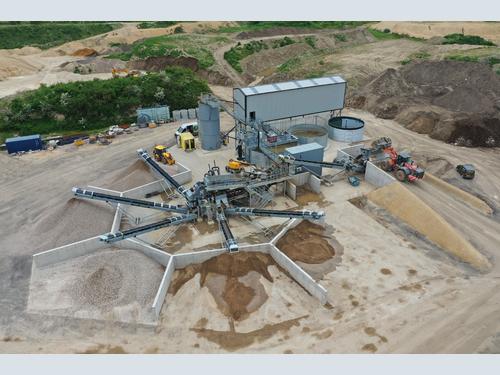
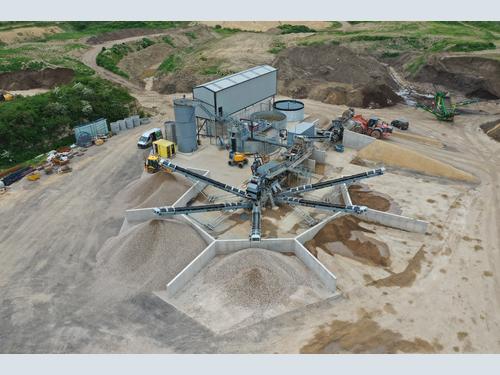
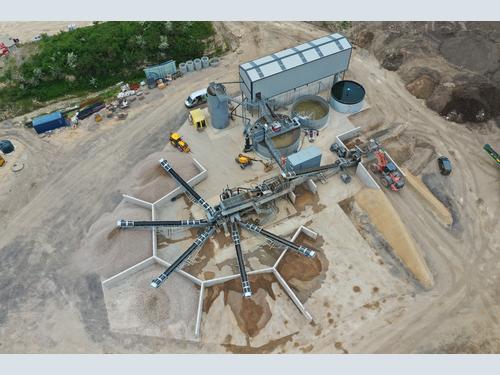
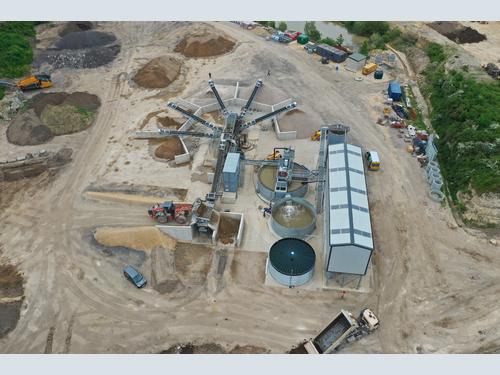
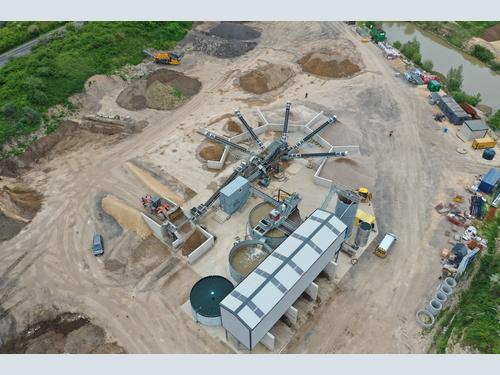
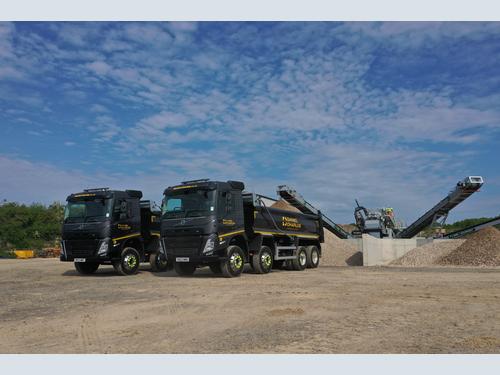
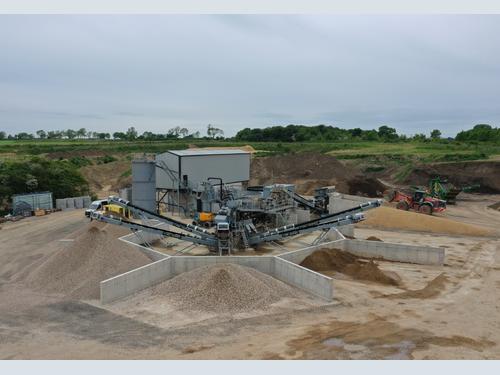
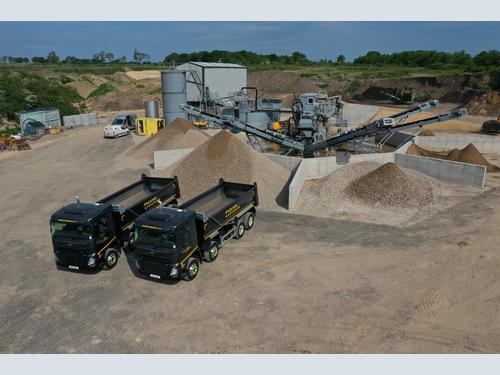
This new plant was installed and commissioned in 2023 at Kirks Quarry, Dunston which is situated south-east of Lincoln.
Kirks quarry has extensive reserves of limestone and a few hundred thousand tons of processed C&D waste where the fines have been removed from the product to create a saleable topsoil. [All material is delivered from the companies own C&D sites in the area along with a small waste transfer station in Lincoln].
Prior to the installation of the plant multiple sample analyses were taken of the inert C&D stockpiled waste after it had passed through a Warrior and designated the middle product. The limestone fines coming off the crushing train were also analysed to understand how much of a benefit washing this by-product would have on the process.
Washing Plant
The plant at Kirks Quarry is centred around an all-electric washing plant, integrating heavy attrition with sizing, lightweight contaminants removal and hydro cyclone based fines recovery on a single highly portable chassis.
Primarily designed for the processing of construction and demolition waste but equally suited to virgin material applications. This recycled aggregate processing plant is capable of producing four grades of aggregate and up to two grades of sand at up to 70tph.
Plant process:
After pre-screening on site, material is then delivered by wheel loader into a 7.5m³ double-deck, live head, heavy-duty hopper. Material is then fed up a 16-metre inclined conveyor and under a ferrous metal overband magnet and delivered onto the Washing Plant where the material is rinsed, scrubbed, and sized through a 2.4m x 1.2m single-deck rinser, which features six isolated spray bars.
Material then passes onto a secondary feed conveyor under a second overband magnet into the twin-shaft log washer with the blades conveying the material from the feed end of the scrub.
Any organics such as roots are floated off to be dewatered over a 1.8m x 0.6m trash screen [An angle adjustment on the log washer allows increased material retention and removal of trash].
Underflow from the trash screen is received in a catch box under the screen and then gravity fed to the sump tank under the hull. Any fines off the back end of the log washer are sent to the two rubber lined 375mm cyclones via two rubber lined 125/100 pumps. The 0-2mm, soft and 0-5mm, sharp sand are then dewatered and stockpiled.
Scrubbed aggregate then exits the main discharge of the log washer onto a 2.4m x 1.2m double-deck sizing screen which splits the required products of 10mm, 20mm and 20-50mm aggregate which are then stockpiled by 3 x 15m channel frame conveyors.
The Water Treatment Plant:
The fully integrated water treatment plant at Kirks Quarry, consists of a 10mØ thickener which has a 230m³ volume capacity with a low flocculent consumption. The plant has the facility to dose, flocculants, coagulants, and anti-foaming polymers, to facilitate the processing of more difficult applications.
An 8mØ clarified water tank provides a 125m³ capacity with a ground-level technical room housing the flocculant dosing unit.
95% of the water used in the washing process can be re-used. The dirty water is collected in a sump before being treated and allowed to settle in the thickener. The thickened sludge is then sent to a buffer tank to control the density of the sludge prior to being compressed within the 1500mm x 1500mm x 180 plate filter press enabling the last remaining water to be sent back into the system. DCA are then able to use the 30mm filter cakes that are expelled from the filter press.
The filter press is housed in a bespoke building with walkways around all sides. It operates up to 21 bar feed pressure and features a rapid plate opening and closing system with an automatic shaker system and electric control panel complete with PLC.
The water treatment plant at Kirks Quarry receives the “dirty water” from the washing process with a double target: Clarifying the water to be able to recycle it and concentrate the sludge.
Flocculation principle:
Flocculation consists in mixing the “dirty water” (i.e. water + dry solids in suspension) with a synthetic polymer having a high molecular weight forming a long macromolecular chain (flocculent). This polymer, characterized by its superficial electric tension, acts on the surface tension of the fines to gather them and form “flocs” which could then have an acceptable settling speed.
Preparation and dosing of the flocculant: DOSAFLOC:
The flocculant is delivered as a white powder soluble in water and producing a highly viscous solution. Its preparation at a concentration rate between 2 and 4 g/l is made in 2 stages:
- A first dilution of the flocculant delivered from a powder hopper by means of an Archimedes screw distributor and homogenization in a primary tank fitted with a low-speed agitator.
- Transfer into a second tank (for maturation) before injection and dosing of the flocculent solution is made through a pump fitted with a frequency variator.
Conditioning of the dirty water:
The “dirty water” coming from the cyclone overflow is mixed with the flocculant solution prepared by the Dosafloc. An additional and final dilution of the flocculant solution through cyclonic spreaders enables to optimize this mixing in the flocculation box fitted with baffle plates. Once prepared the water is directed by gravity into the central feed shaft.
Flocculation Controller:
Sequentially, a sample of flocculated water is taken from the central shaft and the settling speed is measured by the Controlfloc, a glass tube fitted with optical cells. This information is then transferred to the PLC which automatically adjusts the flocculant dosing pump’s flow (according to the settings entered during the commissioning stage) in order to optimize the flocculation efficiency and consumption.
After each measure, the glass tube is automatically rinsed. Samples are taken with a vacuum system to avoid using a pump which would distort the measure by breaking the flocs. The optic cells also enable the ability to determine the turbidity of the recycled water and therefore to adjust the coagulant dosing.
Sludge concentration and evacuation:
The sludge settles quickly at the bottom of the 10m diameter thickener where it is concentrated and gathered into the pumping cone thanks to the slow movement of the scraper.
The sludge is then drawn by a pump located alongside the thickener tank (thus offering an easy access for maintenance operation). The choice of the most suitable sludge pump is depending on the requirements in terms of flows and final consistency, as well as the site constraints (pumping distance, geometric head…)
The sludge pumping cycles are controlled according to the measure of the resisting torque applied on the scraper interpreted by the PLC. This gives a reliable information about the quantity and consistency of the sludge at the bottom of the thickener and also offers a safety factor in case of “building up” inside the thickener. If an overload is detected by the invertor, the scraper is automatically and fully lifted to its upper position and then progressively lowered down to dilute the sludge.
Transfer and pumping of recycled waters:
The recycled overflowing waters are discharged in the recycled water storage tank, where the main water pump installed alongside the tank sends it back the washing plant.
An addition of the fresh water is necessary to compensate the losses due to the residual humidity of the dewatered sand and aggregate.
Electrics:
The whole plant is controlled by PLC with touch screen to display the synoptic and to give access to the setting. The main switch and control panel is located inside the technical room.
Jim Clarke – Quarry Manager, commented, “When we looked at all the plans from the various suppliers, PowerX Equipment were the only one who offered us exactly what we wanted.
“From the start of the project to commissioning it was almost a faultless project. They have since ‘start-up’ being with us to assist which is very reassuring and minimizes downtime. All the production team are very happy with the plant build and the support from their engineers when needed.”
Luke Talbot - MD of PowerX, commented, “Our philosophy at PowerX Equipment is that we are committed to supporting DCC long after their plant installation. We understand that the key to their success is having reliable, fully operational equipment to keep productivity flowing and downtime to an absolute minimum.
“This is the philosophy why we have invested in our Spares and Service Division to ensure we not only have a wide range of parts, but also an expert team of fully qualified and experienced engineers available to help our customers with advice, maintenance, and fitting in a timely manner.”
Associated Businesses